
How fast is CGraph? Benchmarking our open-source code-graph engine
We benchmarked CGraph, our open-source code-intelligence engine: 12-198x faster builds than Graphify, a 15.8x faster warm query, and ~82% fewer tokens than the grep-and-read loop AI agents use today.
At NxtSoft we build developer tools in the open, and we measure them the same way we'd expect a client to. CGraph is our native code-intelligence engine: it turns a repository into a queryable knowledge graph so AI coding agents can navigate code by its structure instead of re-reading files with grep. Recently we sat it down against two baselines — an existing Python code-graph tool called Graphify, and the grep-and-read loop agents run today. Here are the headline results.
Faster where it counts
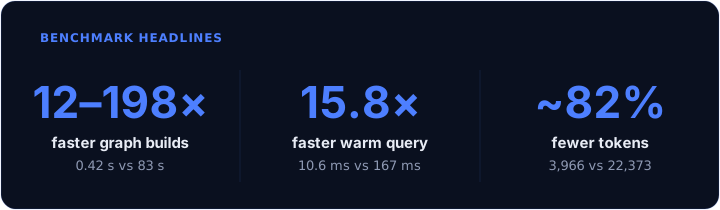
- Builds: 12–198x faster than Graphify. A full graph of CGraph's own repository builds in 0.42 seconds — including community detection and every export — versus 83 seconds for Graphify doing strictly less work.
- Queries: 15.8x faster. Because CGraph keeps the graph resident in a local daemon, a warm query is one in-memory round-trip: 10.6 ms, against 167 ms for a tool that reloads the graph from disk each time.
- Tokens: ~82% fewer. Across four realistic navigation tasks, CGraph answered in 3,966 tokens and 4 calls where a typical grep-and-read agent spent 22,373 tokens across 10 calls — and it turns transitive impact analysis ("what breaks if I change this?") from a tedious manual trace into a single query.
Why it matters
For an AI agent working in a large codebase, most of the cost isn't reasoning — it's re-discovering context it already loaded. A resident code graph collapses that: structure questions cost a few hundred tokens and a single millisecond-scale call, returning file:line ready to open. Cheaper context and fewer round-trips mean agents that move faster and cost less to run.
We're deliberate about honesty here: this was a self-run benchmark on our own repository, and the full write-up publishes the methodology, the caveats (grep is still the right tool for content search), and the scripts so you can reproduce every number yourself.
Read the full technical benchmark — methodology, the complete token-cost table, and where grep still wins — on NxtSoft Labs: Benchmarking CGraph: native code graphs vs Graphify and grep.